
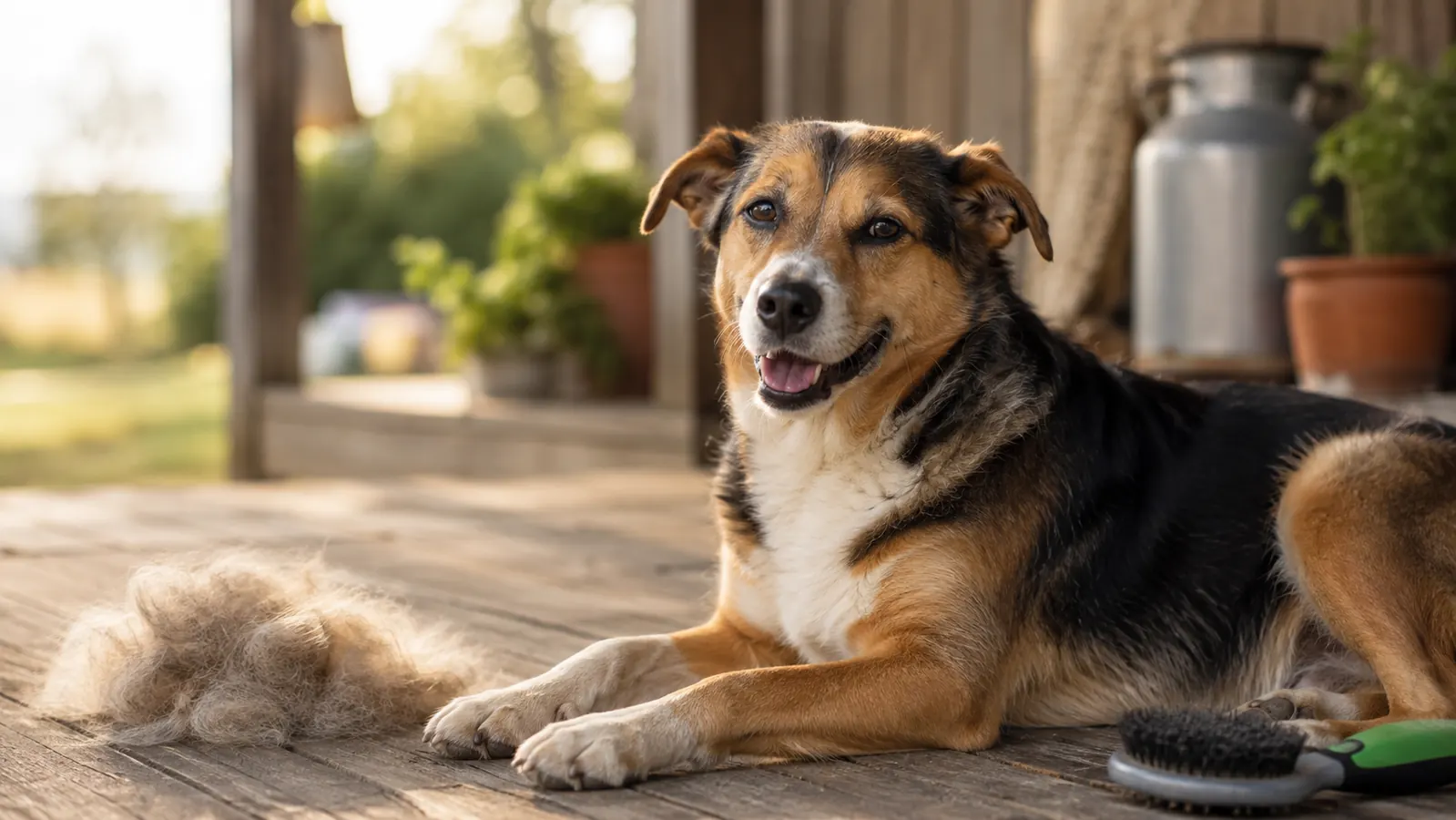
I keep a bucket of failed grooming tools in our mudroom, and the honest label for it would be, 'brushes that cleaned up nice but never met a real shed.' The slicker brush is the one most people grab first because it is cheap, it is sold everywhere, and it makes a coat look smooth in about ten minutes. I used a Hertzko self-cleaning slicker for years and told myself I was on top of it. The problem is that most of what a heavy shedder drops is undercoat, the dense soft grey layer that sits against the skin and comes off in big mats, and a slicker only skims the top of it. So our floor still looked like tumbleweeds no matter how often I brushed, and I kept buying more brushes the way some people buy belts they never wear.
I gave in and bought the FURminator Medium deshedding tool in the spring of 2022, mostly out of pure irritation after vaulting the same corner three mornings running. It did the one thing none of my other brushes ever had: it pulled the undercoat out by the handful. That single difference between the two, reaching down to the base of the coat instead of running across the top, is the whole argument, and it is worth a close look before you put money on either one.
How I Tested Them Both
To make this a fair fight I used both tools on the same two dogs, a 55-pound shepherd mix named Gus and a 65-pound golden cross named Poppy, through a full shed cycle, which for those two runs from about March through June. I brushed one week with the slicker and the next with the FURminator, timed each session with the same kitchen timer, collected the loose fur in a grocery bag, and wrote it all on the calendar the way I track my tomatoes. Same dogs, same shed, roughly the same three to four minutes a side, and I did not let the fur-madness get exaggerated in either direction.
The blunt result after twelve weeks of logged sessions: the FURminator lifted out roughly three to four times as much fur per session, and it came from deeper in the coat, where the shedding actually starts. On a bad week the slicker would fill a thin layer at the bottom of the bag and leave Gus looking brushed but losing fur onto the couch the same afternoon. The FURminator, one pass down the back, would leave a visible mat to peel off the blade. That is the practical difference, and nearly everything else about these two tools follows from it.
| FURminator | Slicker Brush | |
|---|---|---|
| Removes undercoat | Pulls dense undercoat out in full strips | Skims the top guard hairs only |
| Fur captured per session | In our test, three to four times more | Comes out fine and light |
| Coat types it suits | Double coated and heavy shedders | Fine, short, single coats and finishing |
| Cleanup | Push the release tab, wipe off the mat | Self-cleaning button on most models |
| Skill needed | Steady hand and a light touch | Nearly foolproof |
| Up-front cost | Costs more | A fraction of the price |
Where the FURminator Wins
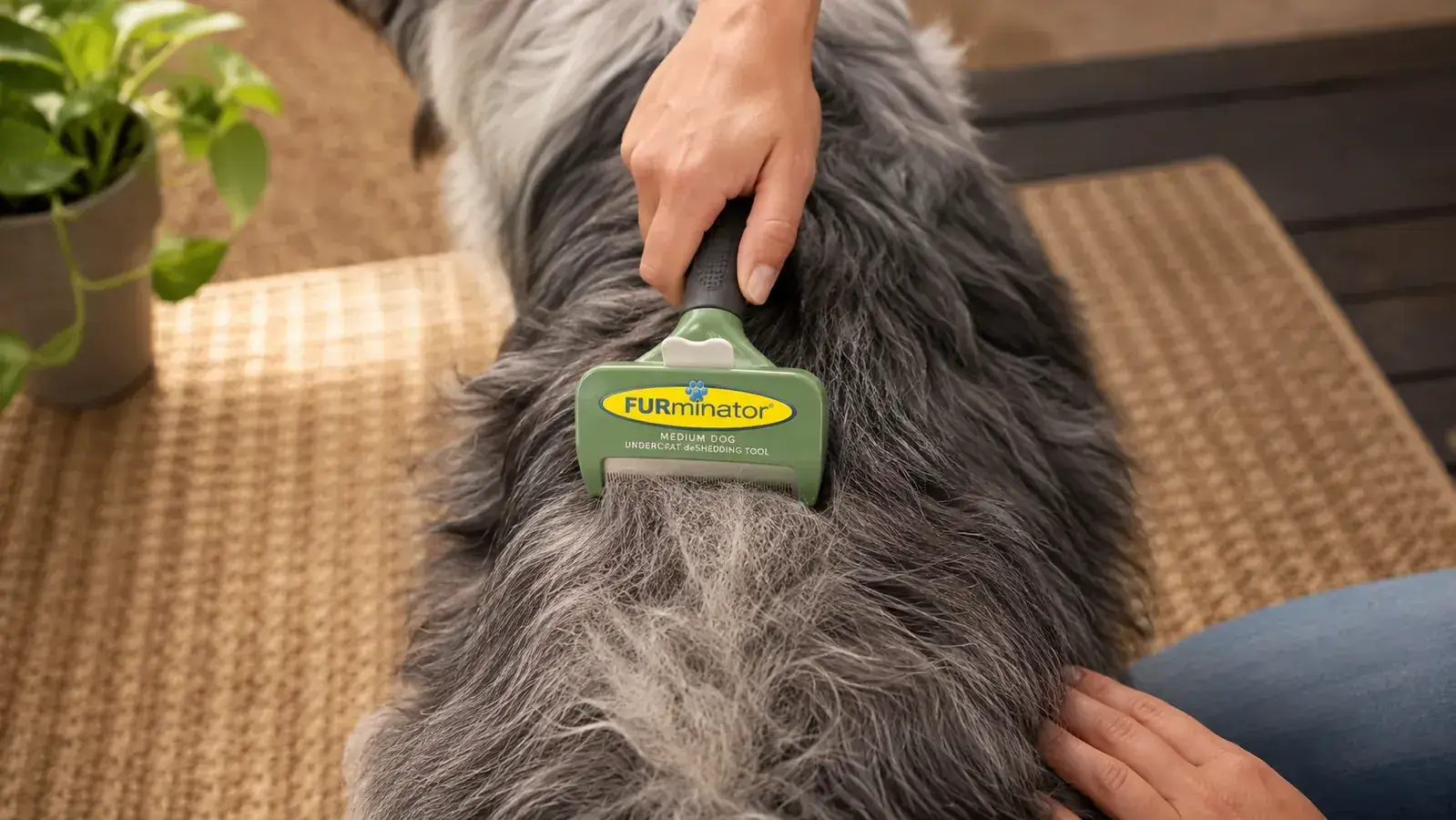
The FURminator beats a slicker at the one job that matters if you actually own a shedder: getting the undercoat out before it lands on your furniture. Its blade is arranged as a row of tiny teeth that reach under the slick top coat and hook the loose undercoat as you pull, and that is the entire difference in one sentence. A slicker works on the surface, so it leaves you brushing the same dog every day and still finding fur on the floor by supper. With the FURminator I often had to stop halfway through one dog and empty the blade, the pile was coming off that fast. That is not marketing talk, that is the thing the tool physically does differently, and it is why the house finally stopped looking snowed on.
It also holds up in a way I did not expect. I have used this one tool for four seasons now, twice a week through the worst of it, and the blade has not rusted and the handle has not cracked after being dropped in the yard more times than I can count. I expected a fussy gadget and found a work tool. And there is a compounding payoff: the more faithfully you groom, the shorter each shed gets. Last spring ours dropped from a solid three months of misery to about six weeks of manageable work, because we were pulling the loose undercoat before it ever settled. Less fur at the base means less fur drifting through the house all season, and that is where this tool quietly earns its keep.
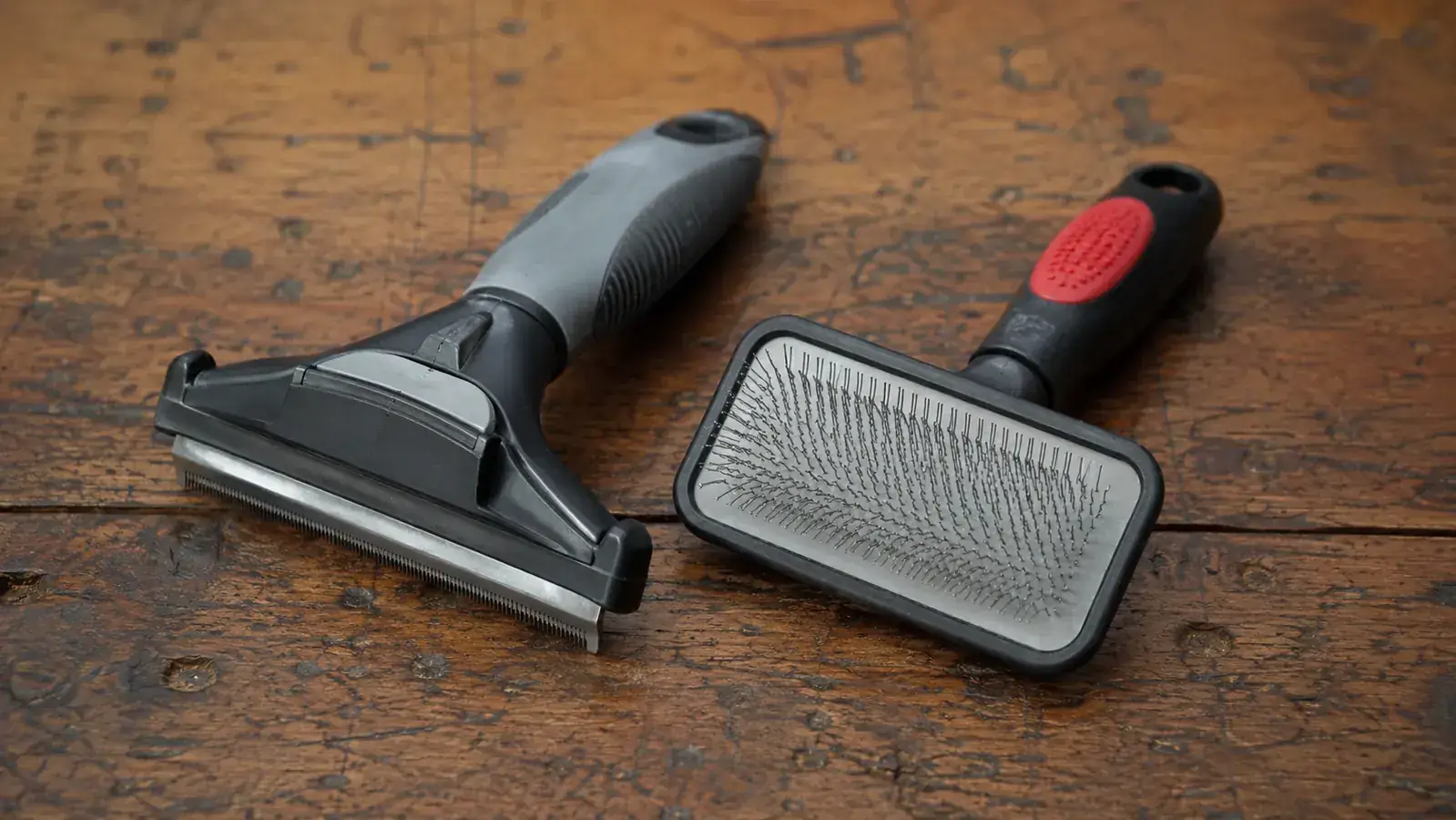
The blade shape deserves a mention on its own, because it is what separates the two. A slicker uses a flat pad of bent pins that drag through the top of the coat and ripple out the loose guard hairs, which looks productive and mostly is not, not where the volume comes from. The FURminator blade is slotted and beveled so it passes under the guard hairs and rakes out the soft undercoat without cutting them. You feel it grab, a firm comb of fur you would never get from a slicker. On Gus, whose undercoat is thick enough to felt a jacket, that grab is the whole reason he stopped leaving a fur shadow on the stairs.
Where a Slicker Brush Wins
Be honest about what a slicker is good at, because it is good at plenty. If your dog has a thin, fine or single coat, or is only a light shedder, the FURminator is overkill and can irritate the skin if you push too hard. A slicker gives that soft, finished, brushed-out look with the least risk and no learning curve, and you can buy a good one for a fraction of what the FURminator costs. Mine cost well under half as much and it is still in my drawer today. It is my go-to for a final smoothing over the FURminator's work, for working out small tangles after a muddy walk, and it is the tool I hand to somebody grooming a dog for the first time, because it is genuinely hard to do harm with it.
The slicker also wins the upkeep argument without even trying. Most take ten seconds to clean, you just push the button at the back and the bristles pull in so the fur falls off the plate, no blade to wipe, no release tab to hunt for. There is no technique to get right, no sweet spot on the angle, no pressure to learn. If your whole relationship with brushing is a quick tidy before bed rather than a weekly extraction, or if you live with a single-coated dog that never piles up an undercoat, the slicker is the right tool and the FURminator would just sit in your drawer collecting dust. They are not the same product doing the same job twice, and the slicker does its own job well.
The Honest Con On The FURminator
I would be lying to my neighbour if I did not say the FURminator takes a steadier hand than a slicker, and that it can be its own worst enemy if you are impatient. It is easy to press down too hard, especially the first time you feel how much fur is coming, and too much pressure on the same spot will wear a sore patch in a hurry. The rule that worked for me is a light touch and short strokes, and never more than two or three passes over the same skin before you move on. If my dogs flinched or turned to look, I was pressing too hard and I lightened up. On a sensitive dog, or a very young puppy, the slicker is the kinder tool for daily use and the FURminator should be reserved for the weekly shed.
Worth saying too that the FURminator is not a detangler and I do not use it on mats. If a tangle has already felted against the skin, going at it with a deshedding blade just tugs and can pull the coat. I work mats out by hand or with the slicker first, then use the FURminator once the coat is running free. Nor is it a substitute for a bath and a proper groom on a long or curly coat. It does one thing, removing loose undercoat from a short to medium double coat, and it does that one thing about as well as any tool I have used. Keep it to that job and it shines. On the two dogs I own it has cut the weekly vacuuming from every other day to twice a week, which is the sort of small, boring win that keeps a tool in the drawer for years instead of a season.
If your dog leaves a fur line on the sofa, this is the tool that actually gets it out
The FURminator Medium is built for double coated and heavy shedding dogs. Check today's price on Amazon and match the size to your dog's coat length.
Amazon Check Today's Price on Amazon →Who Should Buy Which
Buy the FURminator if you have a dog that sheds enough to matter, meaning a double coated or heavy shedding breed that drops visible fur every single day and a genuine avalanche twice a year. That is the household where it pays for itself inside the first shed, because it cuts the problem at the source instead of tidying the top. You have to be willing to learn the light touch and to keep the sessions thoughtful, a few passes per spot at most, since the very thing that makes it effective is also what makes it capable of irritating if you bear down on it. Read the sizing chart too, the medium coat version is what I use for both of mine and it is the right call for most dogs in that range. Order it in the size that matches your dog's coat, not your dog's weight, that is the mistake I saw people make most in the reviews.
Buy a slicker brush if your dog has a fine, single or short coat, sheds lightly, or has sensitive skin, and if what you mostly want is a daily neatening with zero worry. It is gentle, cheap, easy to clean, and basically impossible to misuse, which makes it the right first brush for puppies and the right everyday brush for light shedders. The honest answer most of us land on, and the one I would give over the fence, is that a practical household with a real shedder ends up wanting both. The slicker for the daily finish and for the dogs that do not need heavy extraction, the FURminator for the weekly shed on the two that do, and the floor stays clean between them in a way it never did with either one alone.
To put it in one line: if you have one dog and one drawer to fill, and that dog is a genuine shedder, buy the FURminator first. If your dog barely sheds, save the money and buy a good slicker and nothing else. For the rest of us, start with whichever matches your dog's coat, and know that the other will quietly earn its place by the end of the first spring. Neither tool is a gimmick, they just answer different questions, and knowing which question you are actually asking is where the good buys come from.
Our pick for a real shedder: the FURminator Medium
The same tool we have kept to hand for four years of sheds. See the current price on Amazon and check the sizing guide before you order.
Amazon Check Today's Price on Amazon →