
Let me start with the smell. Not the bin's smell. The smell I used to get every time I opened a fresh bag of kibble two weeks in and it had gone dull. You know the one. The crunch had softened, the bag was half crushed in the corner, and our 12 year old Lab, Gus, would stare at his bowl like I had served him cardboard. That was the problem I was actually trying to solve, and every cheap answer I tried before this bin had failed me.
I had tried clothespins, the roll-and-clip method from a YouTube video, even a big resealable tote from the hardware store that the pantry moths found in about a week. None of it worked for more than a couple of weeks. Eight months ago I finally gave up on improvising and bought the IRIS USA 38 lb airtight container. This is the long-term report, because the first week always looks good. The question was whether it still held eight months in.
The Quick Verdict
The airtight seal does exactly what it promises. Eight months in, kibble stays crunchy to the last scoop, the pantry stays pest free, and it fits a full 38 lb bag with room for a scooper.
Amazon Check Today's Price →Stop Rebuying Soft, Stale Kibble Every Few Weeks
A decade of partly crushed bags and pantry moths ended the day I moved our 38 lb bag into this airtight bin. If your dog is leaving kibble in the bowl, the freshness is the place to check first.
Amazon Check Today's Price on Amazon →How I've Used It
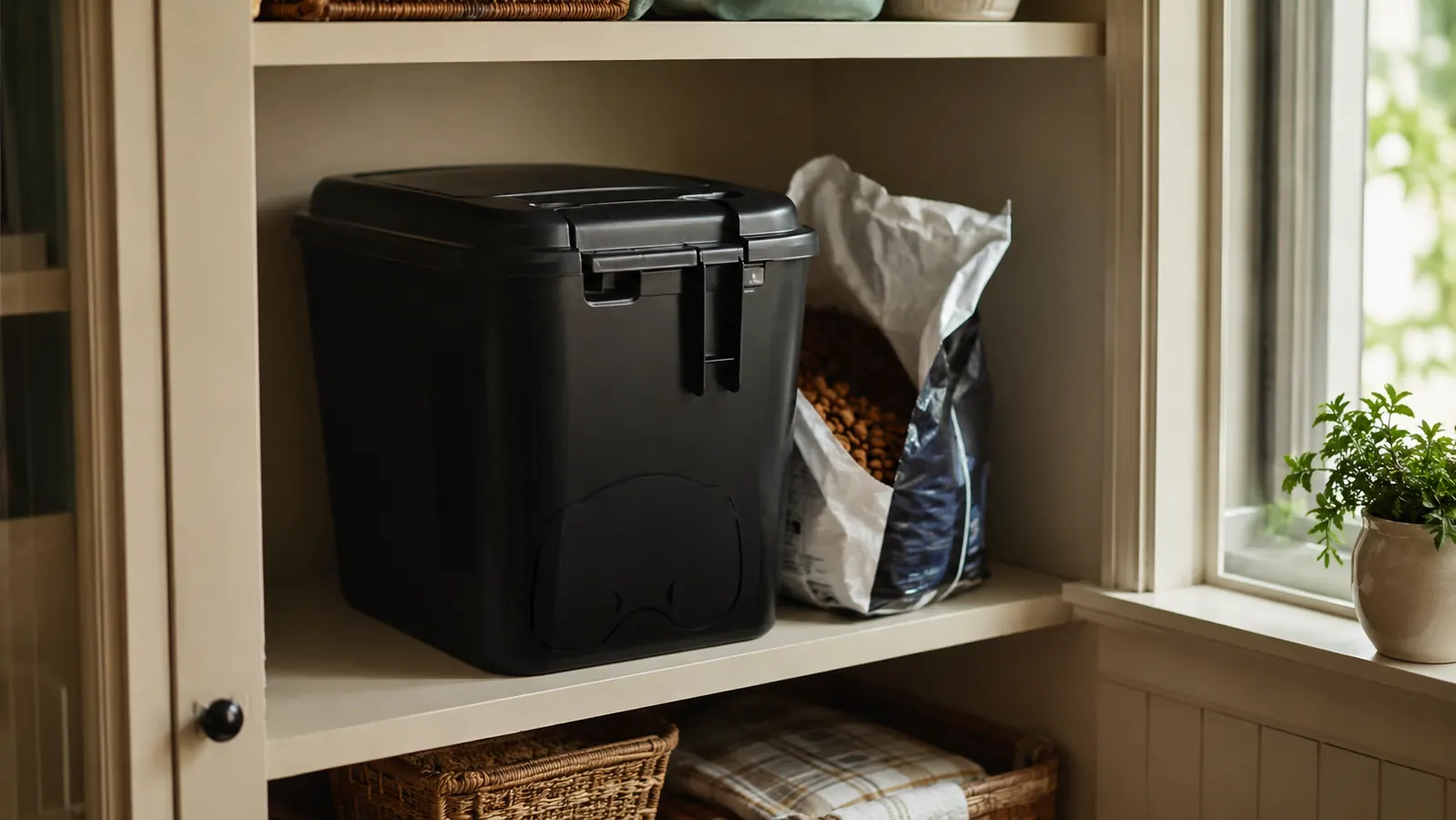
The setup is simple in theory and the bin makes it simple in practice. The lid lifts off, you pour the whole bag in, snap the lid back down, and it seals itself. IRIS USA calls it an airtight gasket seal, and there is a silicone ring running around the inside of the lid that presses against the rim. The handle on top doubles as the latch, and you can feel the seal give when you get it properly closed.
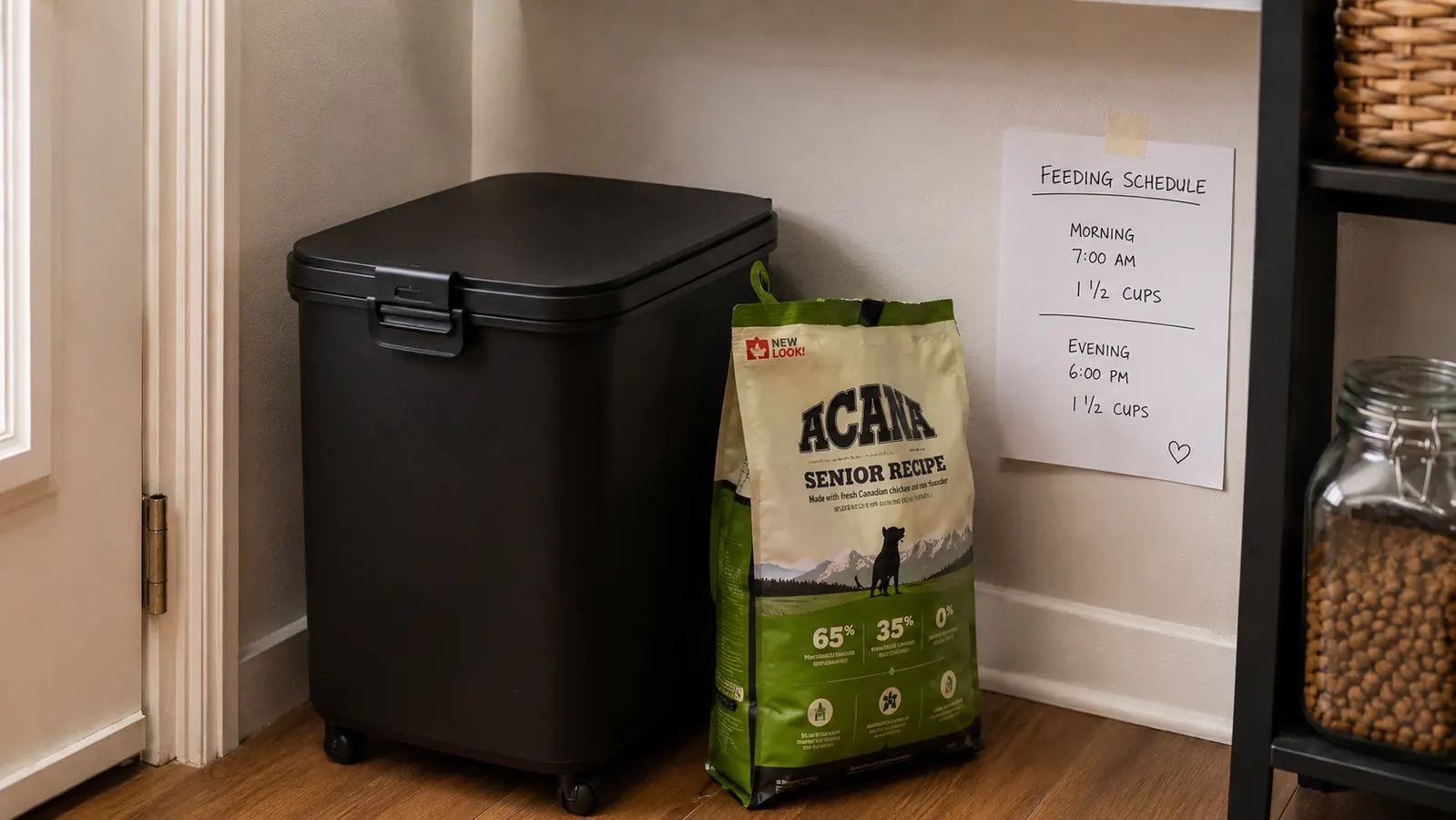
I keep ours on the floor of the pantry beside the upright freezer, because at 38 lb of kibble it gets heavy enough that nobody wants to be lifting it onto a shelf twice a day. Gus weighs 78 lb and thinks the bin is his personal snack dispenser, but the lid clips shut firmly enough that he has never once gotten it off. That matters in this house, because Gus is the same dog who opened a childproof latch on a cabinet once.
The 38 lb size holds a full bag of the kibble we buy with room to spare, which is unusual. Most 'large' storage containers I have owned were really a quarter bag short. I fit the entire 35 lb bag we feed, plus a stainless scooper, and there is still a palm's width of room at the top so I do not have to wrestle the lid down. A note for cat owners: the same bin handles a 16 lb bag of cat food easily, and I grabbed a second smaller one for our cat's dry food.
Because the dog bin worked so well, I bought a second, smaller IRIS container for our cat's dry food and set it on the same shelf. The cat's bag is only 16 lb, so it disappears in the big one, and the smaller size keeps the same gasket seal. It is the same design, just shorter and easier to lift. Having both means every piece of dry food in the house lives behind the same airtight lid, which is what finally got the pantry moths under control for good.
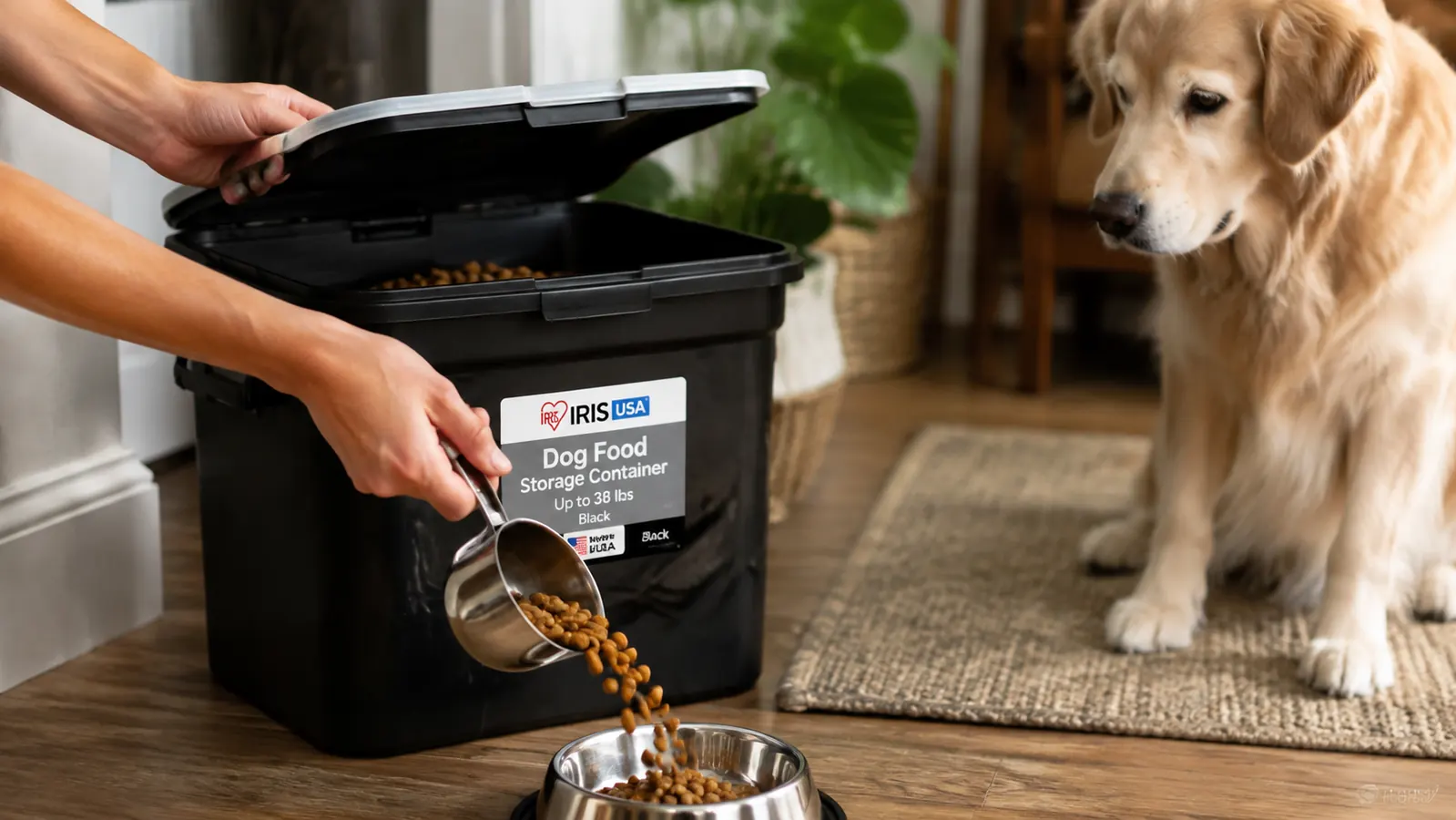
One thing that surprised me was how much calmer feeding time got. Before, every meal started with me wrestling a half-crushed bag out of the corner, fumbling with a clip, and scooping from a bag that never sat straight. Now the bin lives in one spot, the lid comes off with one hand, and I scoop straight from the top. It sounds small, but doing it twice a day, three hundred and sixty five days a year, the difference adds up. A stainless measuring cup lives inside the bin, so I do not hunt for a scoop at six in the morning when Gus is already pacing the kitchen.
The Freshness It Actually Keeps
Freshness is the whole point of an airtight bin, so this is where I paid the most attention. Kibble is coated in fat and sprayed with a preservative blend, and once that coating is exposed to air, it starts to oxidize. That is what turns the smell flat and the crunch mushy over a couple of weeks in a half-open bag. The seal on this bin stops air from getting to the kibble between feedings.
Let me get into the seal itself, because that is the part that actually does the work. The lid has a silicone gasket seated in a groove around the rim, and the handle acts as a cam latch that pulls the lid down tight. When you snap it closed you hear a soft pop as the gasket seats against the plastic. That gasket is what keeps air, moisture, and insects out, all three at once. I ran a small test early on: I closed the bin and pushed on the lid, and you can feel the air pressure hold. It does not just rest on top of the container, it actually seals.
Eight months in, I am confident saying it works. The last scoop from a bag that had been in the bin for three weeks crunched exactly like the first scoop. Gus, who had been leaving more and more kibble in his bowl every week, started cleaning his dish again within a few days of the swap. I cannot prove the food tastes better to him, but I can prove his bowl was consistently empty, and that is the practical test that matters to a dog owner.
There is one honest caveat here. UV light and temperature still affect stored kibble no matter how good the seal is. I keep the bin out of direct sunlight and in a pantry that stays cool through the summer. If you park it in a hot garage in July, the fat in the kibble will go rancid faster no matter what bin you buy. The seal buys you freshness, but it does not buy you a desert in August.
What It Did For The Pantry Pests
This was the nervous part of the test for me. Before this bin, we had a pantry moth problem that kept coming back no matter how many traps I set. The moths laid eggs in the dog food bag, and by the time I noticed the little webby threads it was usually too late. I had thrown away two half-used bags that way and done a full pantry purge once. It was exhausting.
Eight months with the airtight bin and there has been exactly one moth incident, and it was one I caused myself. I left a fresh, unopened bag of kibble sitting outside the bin for a day and a half because I was being lazy, and that bag picked up a few moths before I moved it. The bin itself never let a single one in. I checked the gasket monthly and wiped the rim clean, and the seal held every time.
The moisture side matters as much as the moths. A half-open bag in a humid back room can pick up enough dampness to clump the kibble at the bottom, and that clumped layer is exactly where mold likes to start. I have not seen a single clump in the bin in eight months. The seal keeps the humidity out of the interior, so the kibble at the bottom two or three scoops stays as dry as the first. Combined with my once a month wipe down, where I pull the bin out, rinse it, and dry it completely before refilling, the whole setup has been maintenance light in a way my old bag and clip system never was.
The first three weeks of a fresh bag are where I always lost kibble to staleness and moths. This bin moved the fight to zero in eight months, and the one time we saw moths, it was because I left the bag outside the bin, not because the bin failed.
What I Liked
- The airtight gasket seal keeps kibble crunchy to the last scoop, confirmed over eight months of daily use
- Fits a full 35 to 38 lb bag with room to spare for a scooper
- The latching lid stops a determined dog, ours never got it open
- Easy to wipe down, the plastic does not stain or hold smells
- Made in the USA and comes in sizes down to 5 lb for cat food and treats
Where It Falls Short
- Heavy once full, you will not want to move it between rooms
- The scoop hook on the lid is a nice touch but easy to knock off when the bin is full
- Plastic still needs a cool, dark spot; it will not save kibble left in a hot garage
- No wheels, so you slide it or lift it every feeding
The Build Quality After Eight Months
I am hard on storage gear, so I watched the seams and the gasket more than the fancy features. The plastic is thick, not the flimsy kind that flexes when you push on it, and it has held up to being bumped by the freezer door and swept around on the pantry floor almost daily. The label says made in the USA, which matters to me, and the build matches that claim.
The gasket is the one part I expected to wear out, and after eight months it is still soft and seated correctly. I wipe the rim with a damp cloth every couple of weeks and check that the silicone ring has not cracked or rolled out of its groove. It has not. The lid still snaps down with that satisfying click, and the handle has not stretched or loosened from daily lifting.
Cleaning is where a lot of food storage bins let you down, and this one did not. When I do a full pantry day about once a month, I rinse the bin with hot soapy water and a sponge, and it comes clean in one pass. The inside is smooth with no corners and crevices for old kibble dust to hide in, which is the exact thing that attracts pests in the first place.
The feeding routine has also taught me where the design is smart and where it is merely fine. I like that the bin has a scoop cradle on the lid, so the measuring cup always has a home instead of rolling around the pantry. I like that the lid keeps its seal even when I do not line it up perfectly, because at six in the morning I am rarely careful. What I would change is the footprint when the lid is off; it takes a moment to find a flat place to set it while I scoop. It is a small gripe, and it does not cost any freshness, but it is the one thing I notice every day.
Who This Is For
This bin is for anyone who buys dog or cat food in bags bigger than a couple of servings and has ever thrown a half bag away. If your kibble goes soft before it runs out, or you have waged a losing war on pantry moths, or your dog is smart enough to get into a bag left on the floor, this is the fix. It is also genuinely good for multi pet households feeding more than one animal, because the 38 lb size holds a full large-bag ration with room to spare.
You do not need to be someone who tracks freshness obsessively to get value, and I say that as someone who is not. Our own use is the proof. I bought this bin because I was tired of throwing money into the trash, buying new bags before the old ones were gone, and cleaning up after moths. Eight months later I have not thrown a single scoop away. The bin paid for itself in the first couple of months of not rebuying food that had already gone stale.
Who Should Skip It
If you feed one small dog and buy food in 5 or 10 lb bags that are gone in a week, this bin is more than you need, and the smaller IRIS USA sizes will serve you better. Skip it too if you keep food in a hot garage, because no plastic bin is going to fix a rancidity problem that starts with temperature. And if you want to move the bin around the house a lot, I would look at a smaller size; at a full 38 lb load this one stays planted where you put it.
Make This The Last Stale Bag You Ever Feed
Eight months in, the airtight seal has meant no soft kibble, no moths in the bin, and a dog who cleans his dish again. If freshness is a fight in your house, this is the tool that ends it.
Amazon Check Today's Price on Amazon →