

The night we brought Rusty home I stood in the pet aisle talking myself out of it. A crate is a crate, I told my wife, any one of them will do, and she gave me the look that means I will be right back here in six months. I grabbed the fabric pop-up because it folded into a neat bag and cost less, and three nights later I was on my hands and knees at 2am watching our nine-month-old lab mix push the whole soft-sided thing across the linoleum like it was a sled she was proud of.
That fabric crate went back to the store the same week, and in its place came the MidWest 30-inch double door iCrate. This review is the version you do not normally get, because most crate write-ups start with a clean crate, a sleeping dog, and a beam of golden light. Mine starts with the morning I wiped puppy mess out of the pan at 6am before coffee, and it only gets more honest from there.
The Quick Verdict
A sturdy wire crate that is genuinely the easiest thing in the house to clean and survives a rambunctious puppy, as long as you buy the right size, use the divider properly, and accept that a wire crate is never quiet in a bedroom.
Amazon Check Today's Price →The crate that survived our fabric-crate disaster
After the soft-sided crate lasted exactly three nights with a growing lab mix, the MidWest double door iCrate became the house crate. It is the one we reach for for feeding, travel, and every muddy evening since.
Amazon Check Today's Price on Amazon →How I've Used This Crate
Before I give you the verdict, here is the exact setup, so you can judge it against your own dog. This is the 30-inch MidWest designed for medium breeds, roughly 21 to 40 lbs. Our house runs one medium dog, the lab mix Rusty, now about 35 lbs and still growing into her paws, plus a senior cat named Beans who naps on top of the crate whenever the dog is out. The crate does triple duty: it is Rusty's daytime den while I work in my shop, it travels folded flat in the back of the truck, and it is the pen she sits in for the ten minutes a day when we are eating and cannot have her jaw in the middle of the table.
The reason I keep emphasizing the wipe-it-down part is that this is a house with a puppy and a working shop, so the crate has seen mud, sawdust from boots, a leaky water bowl, and accidents during the crate-training weeks. That is the test that separates a keeper from a regret, and it is the test that no glossy review ever puts a crate through.

The Size Math Is The Real Decision
Nobody tells you that the hard part of buying this crate is not the build, it is the sizing. A crate should be big enough for a dog to stand, turn around, and lie flat, and no bigger, because a dog will treat any extra space as a bathroom wing and you will regret the generosity at 6am. The 30-inch is ideal for the 21 to 40 lb band. For a dog much past 45 lbs you would want to step up to the 36-inch, and many people size wrong the first time and end up exchanging.
This is also where the divider panel matters, and it is the part of the box everyone forgets to mention. The MidWest ships with a metal divider you can slide in to shrink the crate down for a growing puppy. With Rusty we kept the divider in for the first month so she was not staring at all that empty floor at night. That one panel is worth more than half the tricks in any potty-training book, because it keeps a puppy honest about where the sleeping space ends.
What The Double Doors Actually Do
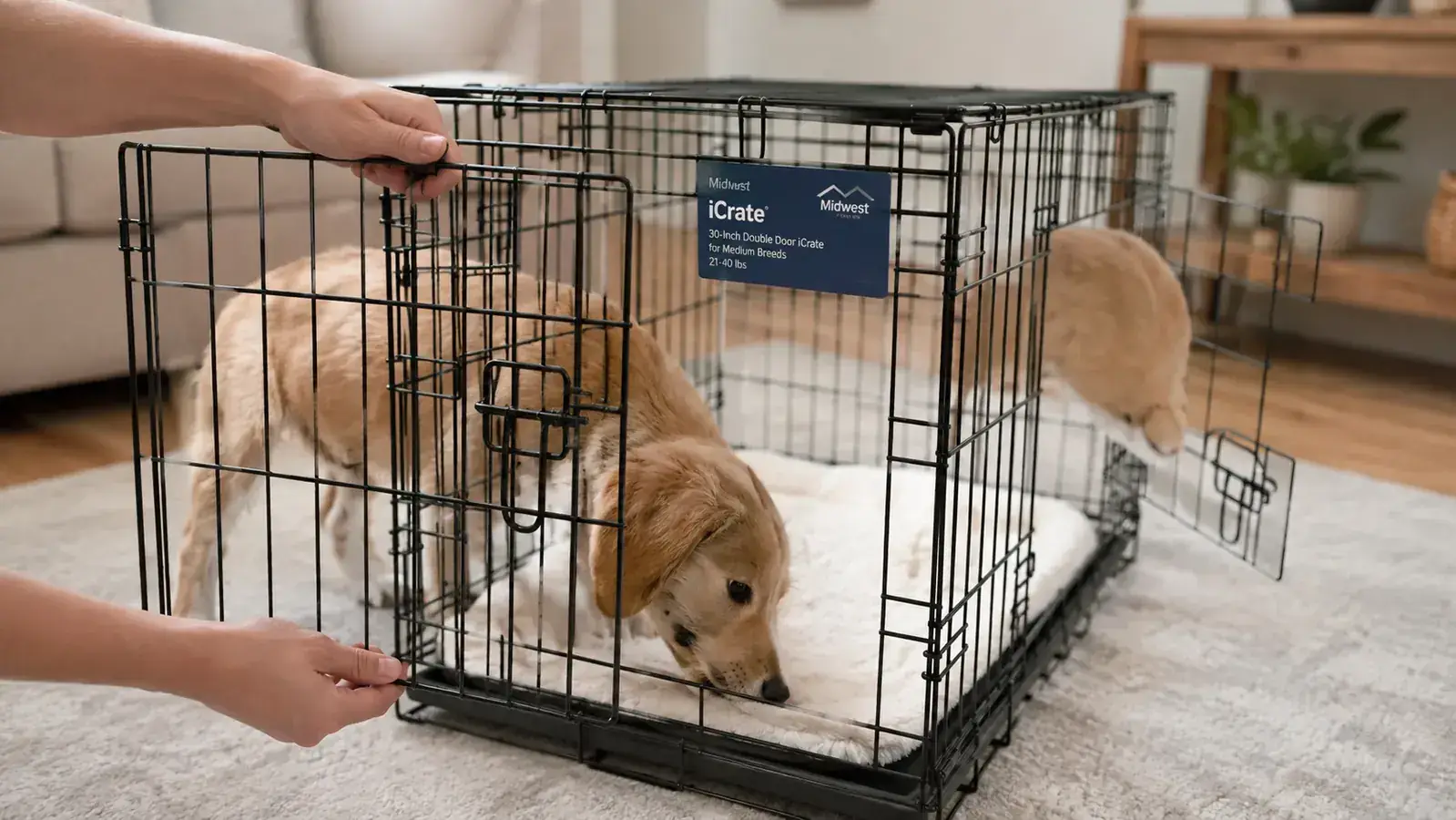
I bought this crate because it was on the shelf and the price was reasonable. The two doors turned out to be the detail I would now insist on, and I did not expect it to matter. The main door swings wide on the front, wide enough that Rusty climbs in without ducking. The extra door on the side is the one that earns its keep in a real house.
When the crate sits against a wall, and most crates do, that side door is the opening that is not pressed against the drywall. It is how I slide the water bowl in and out without crawling, and it is how the crate behaves in the truck on the way to the lake. Set it front-first against the rear seat and load Rusty from the side door instead of trying to angle her through the tailgate. Five minutes of fiddling on the first trip and you will wonder why every crate is not built this way.
Buy One Size And Let The Divider Do The Growing
Here is the sizing strategy that saved us money and a second crate. We knew Rusty would likely top out around 40 lbs, so we bought the 30-inch and let the divider do the early work instead of buying one crate now and a bigger one later. For the first month the panel kept her in a snug sleeping space so she was not tempted to use the far corner, and when she outgrew that space we slid the panel out in about ten seconds. Buy for the dog she will become, let the divider fill the gap in between, and you only ever buy one crate.
The Honest Parts: What Rattles And What Scuffs
Now the part the photos skip. First, the pan. The MidWest uses a one-piece plastic drip tray that slides out the front, and it is the single most useful cleaning feature of the whole crate because it makes the mess moveable. You do not scrub inside a cage on your knees. You slide the tray out, carry it to the sink, and wipe it down in under five minutes. On accident mornings, that is the difference between a crate that stays in the house and one that heads for the garage.
But that tray is not a deep bin. It is a shallow drip pan, so it does not hold a slow leak from a tipped bowl without spilling over the edge, and a really determined puppy can get liquid past it. I fixed that with a cheap boot tray underneath, and now I wish I had read that tip before I wiped the floor the first three times. The pan is durable and easy to find for less than the cost of lunch, so it is not a dealbreaker, but it is not the leak-proof fortress the box art implies.
Before the gripes, a word on putting it together, because this is the part people assume will be a fight. The crate goes together in minutes with no tools at all. The panels click into place, you hinge the two doors on, and the whole thing locks with the same slide latches that hold the doors shut. Taking it down for travel reverses the steps once you find the right panel order. After the first build you can do it from feel in the dark, which is more than I can say for most flat-pack anything we own.
Second, the floor. The crate has small plastic feet built into the bottom of the wire frame, and they protect the wire from being ground flat on concrete, which is good. But those feet are not felt pads, so on a bare wood floor the crate will slide a little when a dog shifts, and the feet can leave faint scuff marks if you drag it around. Put it on a rug or a mat and the problem disappears. Do not be the person I was on day two, sliding a 19 lb wire crate back and forth across the dining room because I had not thought about it.
Third, the sound. A wire crate is not silent, and I refuse to pretend the night noises do not exist. When Rusty turns over, the tray and the panels settle with a little metallic click. In a quiet bedroom that will drive some people up the wall. Ours lives in the living room and the truck, so it does not bother us, but you should hear it here instead of finding out on night one with a light sleeper.
There is one more honest quirk worth a paragraph, and it is the one that surprises people most. The crate does not come with a pad, a cover, or anything soft, and the wire floor is not something a dog wants to lie on bare. You will spend a little extra on a crate pad, and in winter we throw a cover over the top so the warmth stays in. That is not a reason to skip it, every crate owner ends up buying a pad anyway, but it is part of the real cost and I would rather you budget for it up front than resent it later.
How It Handled The Wipe-It-Down Year
Let me give you the ledger for a full year as honestly as I can. We have cleaned more messes out of this crate than I care to count, and we have never once had to take the crate apart to do it. Everything comes clean with the slide-out pan, a hose for the wire frame, and a vinegar solution that knocks out odors without leaving a smell. The fabric crate we borrowed from a friend soaked up exactly one wet day and we could never get the musty note out of it. This one has been through a hundred wipes and it is still odor-free.
On the feeding and travel side, the 30-inch has been exactly right for Rusty's size. We feed her in the crate with the inner bowl near the door, so it is easy to reach in and set down and no mess escapes the tray. On trips to the lake the crate rides folded in the truck bed and sets up in about twenty seconds at the cabin, and because the sides stay open and airy she has never once seemed to overheat the way she might in a closed carrier. That airflow is the quiet win nobody photographs.
The house angle is worth more than most buyers think. Because the top of this crate is flat and solid, our cat Beans has claimed it as her lookout perch, and a cat treating wire as furniture is part of why we trust the build around the chewing dog. For Rusty it is the one place she settles on her own, quiet and open enough to see the whole room, which is exactly what crate training is supposed to give a nervous young dog: a den that is also part of the family living space.
Rusty has chewed the corners of her bed pad but she has never managed to damage the crate itself. The wire is thicker than the cheap crate I owned years ago, and the powder coating has held up through a year of teenage-dog abuse with only one small chip low on the front where her claws find the panel every day. No rust, no bent welds, no latch that sticks. For a crate that gets folded, unfolded, dragged through mud season, and used as a step by a cat, that is genuinely good.
The test that separates a keeper from a regret is not how a crate looks in a photo, it is how it wipes down at 6am after a puppy accident. This one passed that test every single morning.
The Trades You Are Making
For the honest full picture, the iCrate is not for everyone, and pretending otherwise would not help you. A wire crate is open and airy, which is excellent for airflow in summer and excellent for crate training, because a nervous dog can see you and the open door and settle faster than one staring at a solid wall. But that openness means it does not feel like the cozy den a fabric or solid crate provides, so you will want a pad and a cover in winter.
It is also heavier than a fabric crate, around 19 lbs, and it does not fold into a tidy carry bag. It folds flat in about twenty seconds and re-erects the same width every time, but it is a flat panel of wire you lean against a wall, not something you sling over your shoulder. If your only need is a feather-light crate for an airline cabin, this is not that crate. If your need is an everyday workhorse for a growing, mess-making, car-riding dog, this is close to ideal.
What I Liked
- Slide-out drip tray makes cleanup the easiest of any crate we have owned, no taking it apart
- Double doors, one on the side, make wall placement and loading in the truck genuinely easier
- Divider panel across the width shrinks the crate for a growing puppy and helps potty training
- Thick wire and solid welds hold up to a chewing, clawing, growing dog without bending or rusting
- Folds flat and re-erects square every time for easy travel storage
Where It Falls Short
- The shallow tray is not fully leak-proof and spills over if a water bowl tips, plan for it
- Small plastic feet can scuff a bare wood floor and the crate slides a little without a rug
- It makes a metallic settling sound at night, louder than a fabric crate in a quiet bedroom
- It is heavier and bulkier folded than a fabric pop-up, not an airline cabin crate
Who This Is For
Buy this crate if you have a growing puppy or a medium dog between roughly 20 and 40 lbs, if the crate will live in a busy room rather than a silent bedroom, and if you want something you can hose off, wipe down, and not think about again. It is the right pick for crate training your first dog, for a house with regular messes, and for travel that involves folding a crate into the back of a vehicle. The divider, the side door, and the sliding tray are the three details that make it the easiest training crate we have used.
Who Should Skip It
Skip it if you need a lightweight crate for an airline cabin, because at 19 lbs this is not it. Skip it if your dog is a confirmed, determined wire-bender who has already wrecked metal crates before, because no crate on the shelf substitutes for management and solid training. And if a calm, older dog is only going to nap in a carpeted bedroom, the softer fabric crate may honestly serve you better with less weight and less metallic noise. This crate is built for the messy, active, every-day reality, not for a tidy showcase.
The crate we stopped thinking about
A year of wipe-downs, divider adjustments, and muddy trips later, the MidWest iCrate is the one we stopped second-guessing. If you are done replacing crates every few months, this is the honest long-term pick with two doors, a sliding tray, and a price that keeps looking better.
Amazon Check Today's Price on Amazon →