
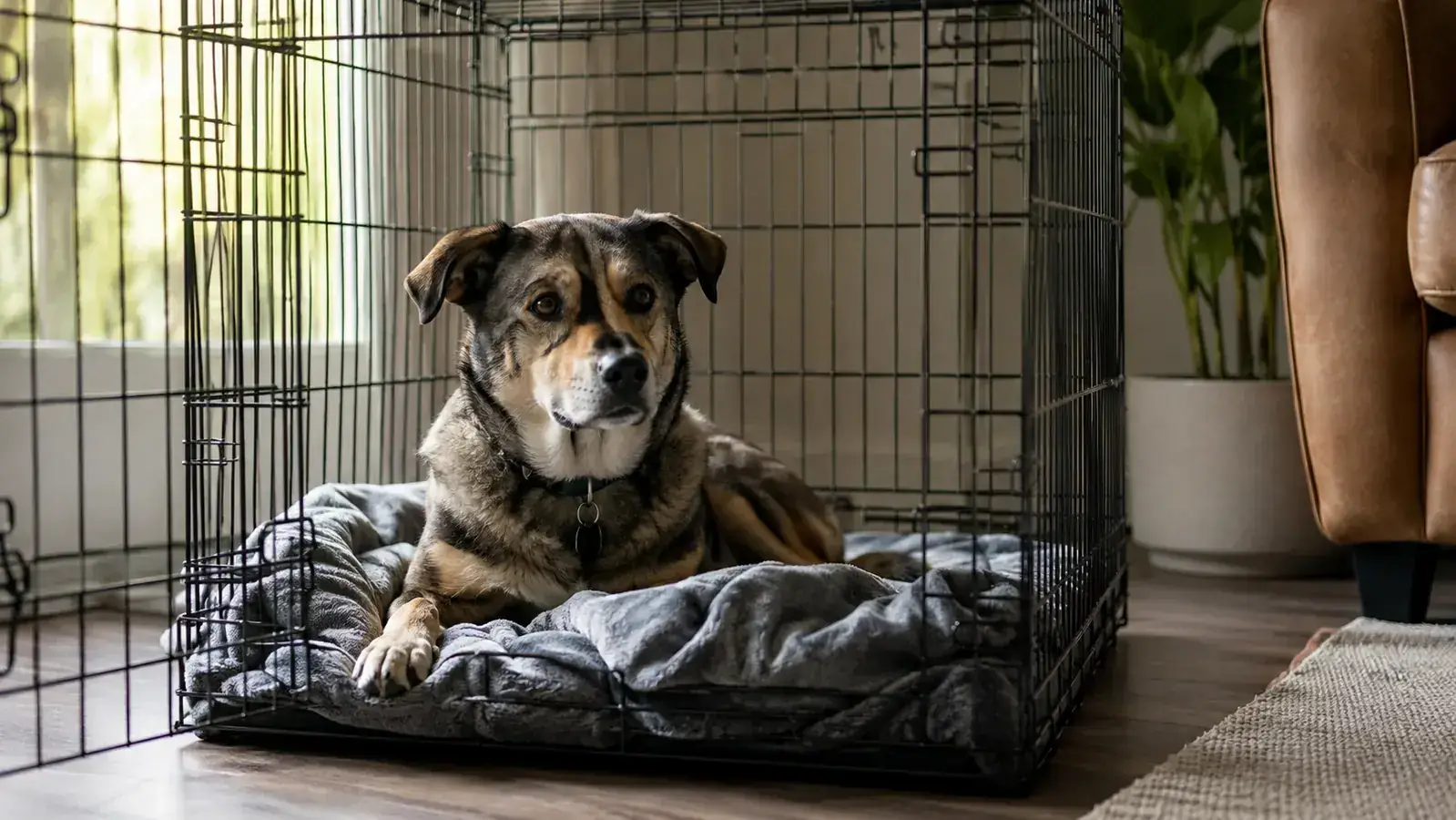
I have had both of these crates in my house at the same time, and that is the only fair way to answer this question. The Midwest wire crate has lived in our living room for three years. The fabric pop-up crate sat on a shelf in the garage for a year and came out only for one rescue puppy and a couple of car rides before I put it away for good. If you are trying to decide between a wire crate and one of those mesh pop-ups that fold up like a camping chair, I can save you the round trip. They are not the same thing doing the same job twice, and the wire one is the all-arounder for most households.
The short answer in one line: buy the wire crate if you need a real, daily, keep-the-dog-safe home that will last years, and consider a fabric pop-up only for the rare occasion when you need something feather-light that notches from nothing. Everything below is the longer, honest version of that sentence, drawn from what I actually lived with both, including the parts I did not expect until I had them side by side in our mudroom.
| Wire Dog Crate | Fabric Pop-Up Crate | |
|---|---|---|
| Durability | Steel wire, survived chewing, scratching and 3 years of daily use | Mesh and fabric, a determined dog can push through or rip it |
| Ventilation | Open on all sides, air flows freely, dog can see out and stay cool | Mesh panels breathe but trap more heat and cut the view |
| Cleaning | Wipe the tray with soapy water, hose it off outside | Must unzip and machine wash the fabric cover, slow to dry |
| Chew resistance | Steel bars shrug off teeth | Zippers, seams and mesh are tempting targets |
| Travel weight | Heavier, folds flat but takes up room and has some heft | Feather-light, collapses to a small circle, one-handed carry |
| Suitability | Crate training, daily home use, longer trips, most dogs | Light travel, vet visits, car rides, mild-mannered small dogs |
Where the Wire Crate Wins
The Midwest iCrate wins on the one thing you actually need a crate to do: hold a dog securely, day in and day out, without giving up. We brought home our 48-pound hound mix Toby when he was a rough rescue who had already chewed through a fabric crate at his foster's house in under a week. I have seen what a motivated dog does to mesh. The steel bars of the wire crate did not even slow him down. He could push on the door, claw at the pan, and work the latch a little, and it all held. That is the difference you cannot see until you need it, and if your dog is a chewer or a strong jumper, you want steel, not fabric, on your side.
Cleaning is where the wire crate quietly wins, and as somebody who has cleaned up after two dogs for decades, I value this more than I should admit. Every couple of weeks I pull the plastic tray out of the bottom, carry it to the sink, and wipe it down with dish soap and warm water. A muddy paw, a tipped water bowl, the occasional accident after a long car ride, none of it is a production. With the fabric crate you cannot do that. You have to unzip the whole cover, wrestle it to the washing machine, and wait overnight for it to dry, and if the puppy had an accident in the car you are making that trip with a dripping, smelly mesh shell. Give me the wipeable tray every time.
Ventilation and visibility matter more than people expect, especially in a warm house or a warm car. The wire crate is open on every side, so air moves through it freely and the dog can watch the room, which calms most anxious dogs because they are not shut off from the family. My anxious border collie mix Sadie settles far faster in the wire crate than she ever did in the mesh one, because she can see me across the kitchen. Fabric crates cut that line of sight and trap more heat through the panels, which is uncomfortable for a panting dog on a summer afternoon. For a daily home crate that a dog will spend real time in, openness is a feature, not a gap.
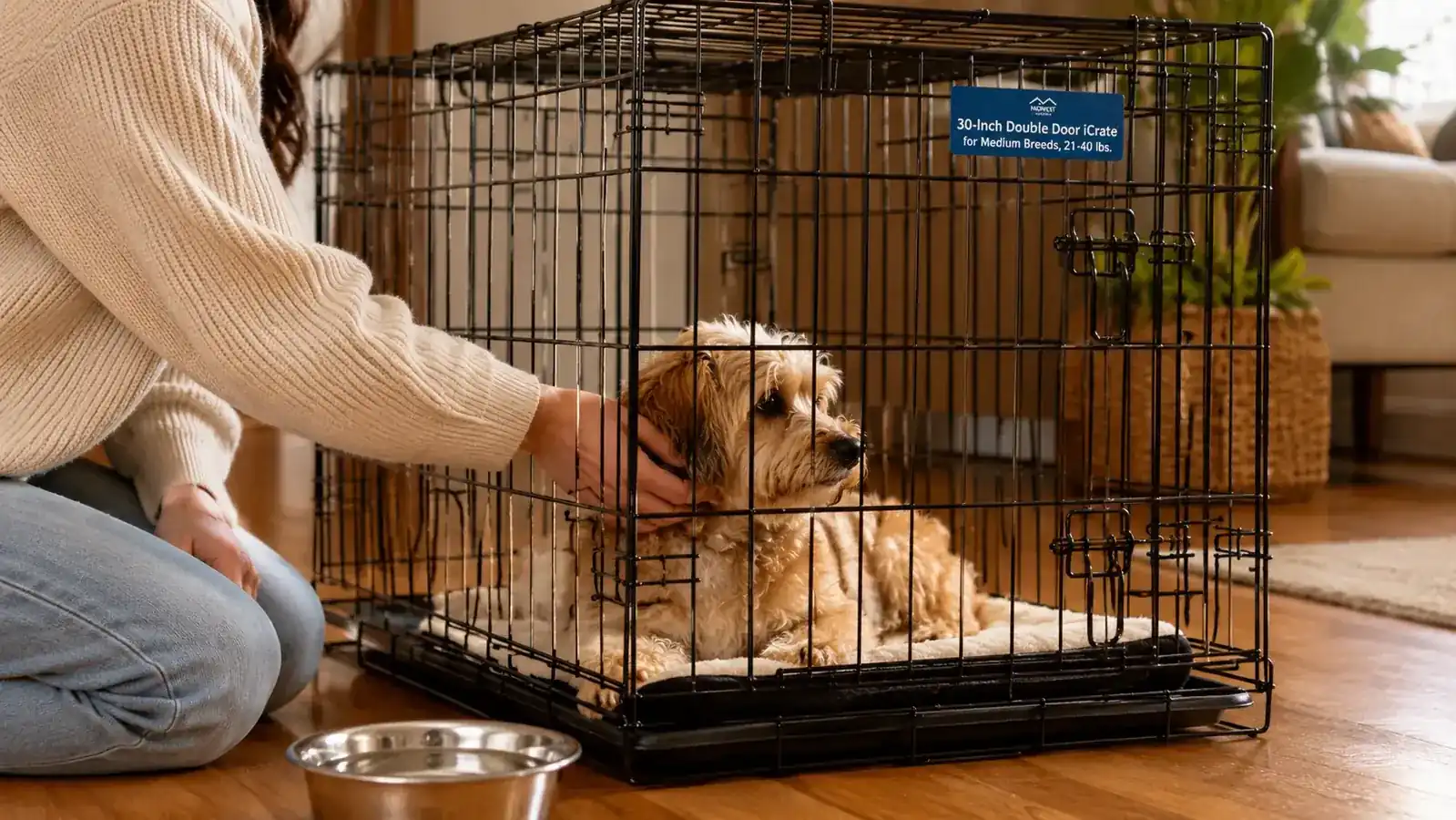
The build quality deserves a mention on its own, because it is what separates a crate you replace from a crate you keep. The Midwest is welded steel with a divider panel so you can grow the space as a puppy grows, two doors that sit where you need them, and a slide-out tray that does not warp or crack in the wash. None of that sounds exciting, but it is the difference between a crate that rattles apart after a year and one that is still sturdy enough to feel reassuring every single day. Ours has been folded, hauled to the car, moved between rooms, and stood on by a curious cat, and it still holds its shape and its lock. That is the durability you are paying for, and it is real.
Where the Fabric Pop-Up Crate Wins
I am not going to pretend the fabric crate has no purpose, because it does, and it is the same reason I bought one in the first place. It folds down to a flat circle about the size of a dinner plate and weighs next to nothing, and you can carry it one-handed while juggling a leash, a bag, and a coffee. For a trip to the vet, a weekend at a relative's house, or a quick car ride with a calm small dog, that portability is genuinely handy. You unclip one spring and it pops open in seconds, no folding panels, no pins, no fighting with stubborn wires. When I needed a quick portable pen for a friend's small calm dog, it was ideal and I was glad to have it.
The fabric crate is also the softer, quieter option if your dog is calm by nature and mostly needs a familiar dark den rather than a fortress. The mesh walls make it feel more like a cave, and a mild-mannered small or medium dog that does not chew will sleep happily in it. It is by far the cheaper option, which tempts a lot of first-time crate buyers, and for the right dog on the right occasion it is genuinely fine. If you picture the crate coming out a handful of times a year and staying folded in the closet the rest of the time, the fabric one does that job with less fuss and less money than the wire crate. That is the honest case for it, and it is a real one.
The trade you accept for that portability is strength. The mesh panels are the whole structure, and a dog that chews, scratches, or pushes hard can deform the frame, work a seam loose, or pop a zipper. They are also lighter on airflow and hotter, so they suit calm, small, mild dogs far better than a strong or anxious one. I would never again trust a fabric crate with a rescue who came to me already traumatized, because the first thing a nervous chewer does in a fabric crate is test every seam. It is a tool for the easy cases, and calling it that is not an insult to it, it is just an honest description of what it is for.
If you want one crate that will outlast the puppy phase, get the wire one
The Midwest 30-inch double door iCrate has held up to three years of a rescue hound and an anxious collie in our house. Match the size to your dog's height and check today's price on Amazon.
Amazon Check Today's Price on Amazon →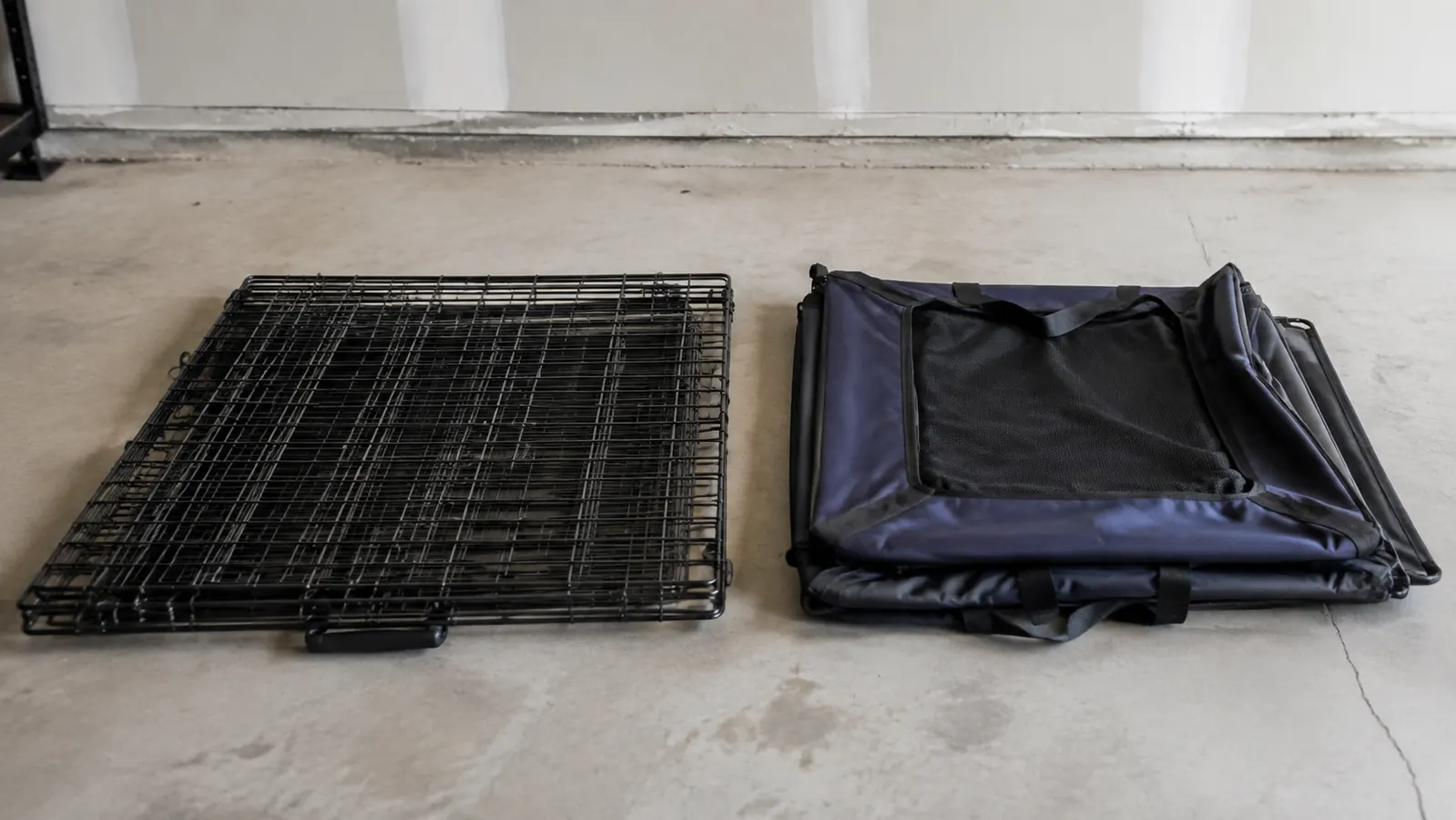
The Safety And The Car Question
Nobody talks enough about the car, and it is where the two crates stop being a style choice and become a safety decision. We travel with our dogs a lot, and I have carried both crates in the back of our wagon. The wire crate rides solid, which matters more than it sounds. In any kind of stop, a sturdy steel crate with the door latched keeps the dog contained against a hard brake, and it cannot be crushed or folded in on itself. The fabric crate has a lighter frame, and the first time I hit the brakes with a fabric crate behind me I could see the whole thing shift, and I did not like what that meant for the dog inside.
There is also the heat factor, which in a parked car is not negotiable. A mesh fabric crate traps more heat and holds less airflow, and on a warm day it gets stuffy fast. The open wire crate lets air move through even with the door closed, which is the safer choice if the dog is ever in the car on a warmer day. Both crates should be strapped or cargo-anchored so they do not slide, and neither should ever sit in a hot car with the windows up. But if I had to pick the one I wanted between me and an impact, or the one I trusted to keep its shape and its latch, it is the wire crate and it is not close.
Who Should Buy Which
Buy the wire crate if you want one crate that does the whole job, whether that is crate training a new puppy, giving an anxious dog a quiet safe den, or hauling a dog on longer trips. It is the better choice for anything that chews, scratches, jumps, or needs to feel like it has a real, sturdy home it can trust. Yes, it costs more and it is heavier and it does not vanish into a closet, but it is a buy-once piece of gear, and in our house it is still carrying the daily load after three years with no sign of giving up. If you are going to crate train at all, and you want the crate to matter, this is the one.
Buy the fabric pop-up crate if your dog is small and calm, if the crate will spend most of its life folded up, and if the occasional trip to the vet or a relative's house is the whole point of owning one. For a mild-mannered dog that does not chew, it is lighter, cheaper, and far easier to store, and it will serve that narrow job well for years. The honest line I would give a neighbor is this: most households with a real dog, meaning any dog with teeth and an opinion, end up happier with the wire crate as the primary. Keep the fabric one as a spare for the easy moments if you like. But pick your main crate on the side of steel, and you will not be replacing it in six months.
There is one more consideration that tipped it for us, and I want to be honest about it: crate training works better in a crate the dog can see out of. The open wire design means a new puppy can watch you while they settle, which is exactly what positive crate training needs, and it is the reason the Midwest is the crate most trainers and rescue groups reach for first. A fabric cave is fine for a dog that already sleeps in a crate with no fuss. But for the training that turns a nervous rescue into a dog that happily curls up in its own corner, the wire crate earns its place. That settled it for our household, and it is the reason this wire crate is still in the living room three years later while the fabric one collects garage dust.
Our pick for the all-around family crate: the Midwest iCrate
The same 30-inch wire crate that has served two of our dogs for three years. See the current price on Amazon and size it to your dog's height at the shoulder. It does the daily home job and the car job with one sturdy piece of steel.
Amazon Check Today's Price on Amazon →